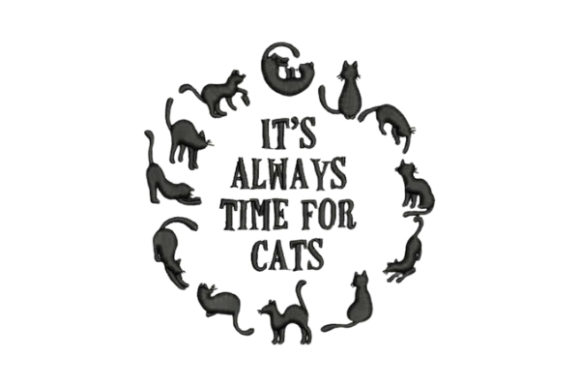
It’s Always Time for Cats
As a designer who’s stitched hundreds of embroidery files for client projects, Etsy shops, and boutique merchandise, I opened It’s Always Time for Cats expecting charm—and got something more: quiet confidence. It’s not flashy, but it’s precisely the kind of machine embroidery design that earns repeat orders, builds brand warmth, and feels handmade without looking labored.
A Design That Breathes With Its Subject
The first thing that stands out is how the phrase settles into itself—soft curves in the lettering, gentle spacing, and that unmistakable satin stitch flow. There’s no aggressive kerning or sharp angles; instead, the words lean just slightly, like a cat stretching in sunlit fabric. It doesn’t shout “cat lover”—it murmurs it. That subtlety makes It’s Always Time for Cats feel personal rather than thematic, which is why it works so well on items meant to be kept close: baby onesies, linen pillow covers, kitchen towels folded neatly on a shelf, or the inside seam of a custom apron.
I tested it recently on a medium-weight cotton tote bag for a local pet rescue’s holiday fundraiser. The design sat cleanly at the lower left corner—no distortion, no puckering—thanks to balanced stitch density and thoughtful letter height. It didn’t compete with the bag’s texture; it complemented it. Customers paused longer than usual. One said, “It feels like it belongs there—not stuck on.” That’s the gold standard for any embroidery file used in real-world product development.
Where It Shines (and Where It Asks for Attention)
It’s Always Time for Cats thrives on stable, low-stretch surfaces: canvas totes, brushed cotton sweatshirts, tea towels, and structured baby blankets. On those, the satin stitch delivers crisp edges and subtle sheen—just enough polish to elevate a handmade product without sacrificing approachability.
It also translates beautifully into embroidered patches. Because the letterforms are open and consistent in weight, they hold up well when heat-applied or sewn onto denim jackets or backpacks. For Etsy sellers listing digital embroidery files, this design is a strong candidate for bundled holiday collections—think “Cat Lover Essentials” alongside simple paw prints or minimalist whisker motifs.
But let’s be practical: avoid using It’s Always Time for Cats on highly textured fabrics like bouclé or thick terry cloth unless you’re willing to double-stabilize and adjust tension. The satin stitch needs a clean surface to lie flat. Similarly, skip ultra-thin fabrics (like voile or lightweight rayon) without backing—the fill can show through or distort. And while it’s legible on dark fabric, test thread color contrast carefully: a soft cream or heather gray thread reads warmer and more intentional than stark white on navy or charcoal.
Real-World Fit Across Your Creative Work
For small shop owners and craft fair vendors, this embroidery file bridges sentiment and simplicity. It’s recognizable at a glance but never cliché—a rare balance for cat-themed design assets. On nursery decor, it adds tenderness without overwhelming; on a custom sweatshirt for a vet tech’s birthday, it feels insider-y and warm. Even as a printable mockup element for your digital product listings, it communicates craftsmanship: clean lines, considered spacing, and rhythm in repetition.
Commercial embroidery users should note: because it relies on satin stitch rather than dense fill or applique layers, it stitches quickly and reliably across most mid-range machines. That means fewer stops for thread breaks or re-hooping during batch production—valuable time saved when embroidering 50+ tote bags for a boutique launch.
Design Notes You’ll Want to Keep Handy
- Always test first. Run It’s Always Time for Cats on scrap fabric matching your final project’s weight and stretch—even if it’s just a corner cut from your main piece.
- Check stabilizer pairing. A medium-weight cutaway works best for apparel; tear-away is fine for towels or tote bags where backing won’t show.
- Review small details. The apostrophe in “It’s” and the curve of the “g” are delicate—zoom in on your embroidery software to confirm clarity before stitching.
- Mock it in context. Drop the embroidery file into a realistic mockup: a folded tea towel, a relaxed-fit sweatshirt sleeve, or a baby blanket corner. Does it anchor the composition—or float?
- Confirm licensing scope. If you plan to sell finished products (e.g., embroidered pillows) or resell the digital embroidery file itself, verify whether the license permits commercial use. Many cat-themed designs include limitations—don’t assume.
- Compare light/dark backgrounds. Try stitching the same design in black thread on ivory linen and ivory thread on deep olive cotton. The mood shifts meaningfully—choose deliberately.
Why This Design Earns Repeat Use
It’s not about novelty—it’s about resonance. It’s Always Time for Cats avoids trend-chasing. No glitter effects, no cartoonish exaggeration, no forced humor. It trusts the subject—and the stitcher—to carry the feeling. That trust pays off in customer trust: buyers recognize sincerity in the finish, and that translates directly to perceived value, repeat purchases, and word-of-mouth referrals.
For creative entrepreneurs building a cohesive line—say, a series of pet-themed kitchen linens or a capsule collection of embroidered baby essentials—this design anchors the collection without dominating it. It pairs effortlessly with solid-color stitching or minimal icon accents, letting your brand voice stay consistent across formats: digital embroidery file, finished product, social media visual, or even packaging stamp.
In short? It’s Always Time for Cats isn’t just another cat quote. It’s a quietly versatile, commercially sound, emotionally grounded embroidery file—one that works as hard as you do.