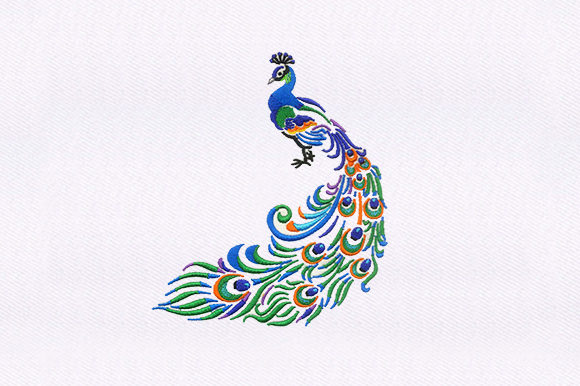
Indian Peacock Embroidery Design
A Boutique Designer’s First Look at Indian Peacock
As an embroidery designer who’s developed collections for small clothing brands and Etsy sellers over the past decade, I approach every new machine embroidery design with a very specific checklist: Does it translate well to apparel? Does it hold visual weight without overwhelming the garment? And—most importantly—does it feel intentional, not generic? When I first opened the Indian Peacock embroidery file from Creative Fabrica, I paused. This isn’t just another bird motif—it’s layered, balanced, and quietly confident. The peacock’s posture is upright but relaxed; the tail feathers fan with rhythmic spacing, not cluttered density. It reads as premium—not overly ornate, not minimalist—but rich in storytelling. It leans feminine and timeless, yet avoids cliché. For boutique apparel, that’s gold.
How Indian Peacock Performs on Sweatshirts & Hoodies
Sweatshirt embroidery demands clarity, stability, and presence—and Indian Peacock delivers across all three. On neutral heather grey or oatmeal sweatshirts, it reads as elevated casual: elegant enough for a curated lifestyle brand, grounded enough for everyday wear. On pastel hoodies—think blush, mint, or lavender—the design lifts the tone without competing. Its natural symmetry makes chest placement intuitive, and its vertical orientation works beautifully on sleeve accents (just rotate 90°) or centered back designs for oversized garments. I tested a scaled-down version (approx. 3.5" tall) on a ribbed cotton hoodie front panel—it held shape cleanly, with no puckering around the feather curves. That said: avoid placing it directly over thick seams or deep ribbing without extra stabilizer. The stitch density feels moderate—not sparse, not aggressive—so it breathes on fleece without sinking in.
Versatility Beyond Apparel: Totes, Denim, and Seasonal Layers
Indian Peacock shines where many bird designs falter: adaptability. On denim jackets, it adds artisanal charm without looking costumey—especially when stitched in matte cotton thread for subtle texture contrast. As a tote bag centerpiece, it anchors the composition without dominating; its clean outer silhouette ensures readability even at 4–5" width. For cozy seasonal layers—think corduroy vests or brushed cotton lounge sets—it brings warmth and quiet sophistication. It also photographs exceptionally well for printable mockups and social media graphics: the feather details catch light softly, and the balanced negative space keeps product shots clean and brand-focused.
Strategic Placement & Fabric Considerations
Not every surface suits Indian Peacock. On highly stretchy knits (like lightweight jersey tees), I recommend using cutaway stabilizer and reducing hoop tension slightly—those delicate feather tips need support during stitching. Avoid tight curves like collar bands or narrow cuffs unless you resize significantly (under 2.5"). On dark garments, choose high-contrast thread colors—navy or charcoal thread can mute the design’s vibrancy; ivory, soft gold, or deep emerald pop with intention. Also note: while the design flows naturally on flat panels, test placement on curved areas (e.g., side seams of oversized hoodies) using a fabric scrap first. The central body of the peacock holds up better than the outermost tail plumes on uneven surfaces.
Building Brand Identity with Thoughtful Embroidery
For small shop owners and handmade product creators, consistency is currency—and Indian Peacock supports that. Its classic yet distinctive personality helps unify a collection without requiring matching fonts or color palettes. Use it across t-shirts, hoodies, and totes, and customers begin to recognize your aesthetic intuitively. That recognition builds buyer trust: when a customer sees Indian Peacock on your Etsy listing, they’re not just buying a sweatshirt—they’re choosing a point of view. It elevates perceived value, too. A $68 cream hoodie with this design feels more intentional—and more justifiably priced—than one with a generic floral. For commercial embroidery shops, it’s a reliable repeat request: recognizable, licensable (confirm terms on Creative Fabrica), and scalable across client projects.
Practical Designer Notes Before You Stitch
Before committing to production, run these checks:
- Test on scrap fabric that matches your final garment’s weight and stretch—especially for fleece or ribbed knit.
- Review stabilizer choice: medium-weight cutaway for most apparel; tear-away only for stable wovens like denim or canvas.
- Confirm hoop size—if your machine requires re-hooping mid-stitch, plan for alignment marks or use a multi-hoop file if available.
- Inspect stitch density visually in your embroidery software: look for smooth feather gradients and no overlapping jumps that could snag.
- Compare placement options—try it centered, left-chest, and sleeve-mounted in mockup tools before cutting into inventory.
- Always verify licensing on Creative Fabrica’s product page before selling finished apparel. Commercial embroidery rights vary by seller.
Final Thoughts for Creative Entrepreneurs
If you’re curating a small-batch collection—whether for your own boutique brand, an Etsy shop, or custom client work—the Indian Peacock embroidery file is more than decoration. It’s a design partner: refined enough for discerning buyers, flexible enough for diverse fabrics, and distinctive enough to stand out in a crowded digital marketplace. It doesn’t shout. It invites closer looking. And in today’s landscape—where handmade authenticity and visual cohesion drive engagement—that quiet confidence is exactly what converts browsers into loyal customers. Whether you’re stitching sweatshirt embroidery for fall launches or building a signature hoodie design library, Indian Peacock earns its place—not as filler, but as foundation.